

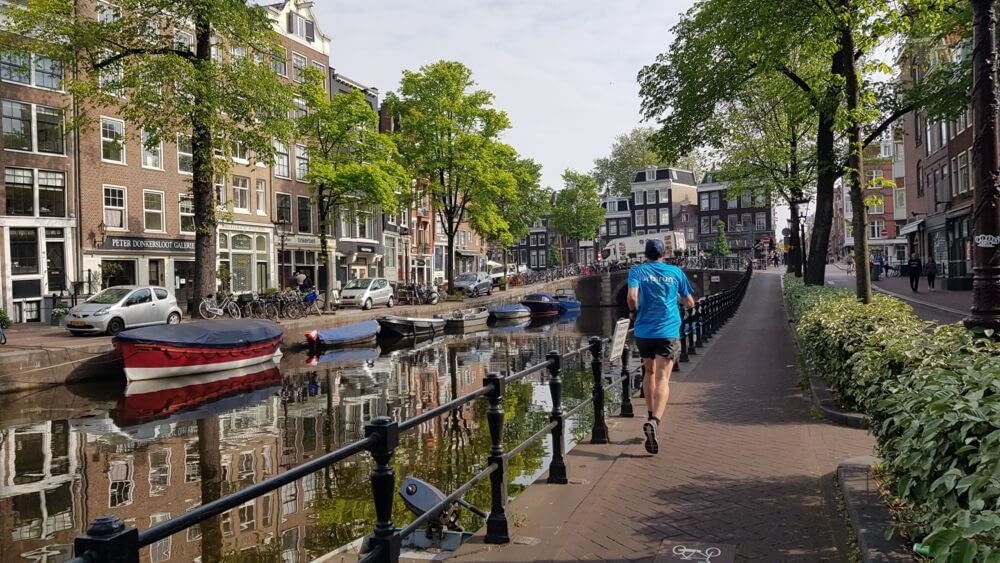
 Running and discovering the best spots in Amsterdam, after downloading you urbirun sightrunning route
 Do you like urbirun? Then why not buy me a coffee or a chocolate chip cookie to encourage me? Thank you very much for your support!



Subscribe to our newsletter and keep up to date with urbirun news, new destinations and exclusive routes.
Join de urbirun newsletterWhat they are and why they matter
Your pace has nothing to do with your running style, your outfit, or how you look doing it. Pace is simply your speed — and each pace zone has its own specific purpose and benefit: easy running, tempo run, threshold, race-specific pace, intervals… Here’s a quick breakdown.
Easy Running / Base Pace
The easy run (65–75% of your vVO2 max) is the session that always feels too easy — and that you end up skipping, thinking it’s not doing much. You’re wrong. And honestly, so am I sometimes, but let’s keep that between us.
At this pace, you can hold a proper conversation. Not necessarily a fascinating one — you’re still the same person, like everyone else — but you can comment on the weather, last night’s game, your colleague’s questionable outfit, or plan your next holiday. If you’re short of breath, you’re going too fast.
This session is the foundation of solid physiological development
— and yes, that’s probably why it’s called “base” training. It builds capillary density in your muscles (nothing to do with your hair — we’re talking about the network of tiny blood vessels supplying your muscles), improves your ability to burn fat as fuel (and who doesn’t love burning fat?), and strengthens your heart and tendons. You’re building the foundations on which everything else rests.
Easy running should make up 60 to 70% of your total training volume, and plays a key role in recovery too. Run slow to run fast: it’s the paradox you need to learn to embrace.
Tempo Run
This is what you’d call “comfortably hard” pace (around 80–85% of your vVO2 max) — just below your lactate threshold. You’re suffering, but in a civilised way. It’s the pace where holding a conversation is still technically possible, though not one centred exclusively on swear words.
A tempo run typically lasts 20 to 40 minutes at a steady intensity, without the effort variations of interval training. It trains your body to sustain a high speed over time, improves running economy, and pushes back the point where things start to feel truly unpleasant.
The difference from a threshold session: the tempo run is slightly less intense and longer. Threshold is the red zone that makes you grimace; tempo is the deep orange that makes you breathe hard. Both deliver real progress.
 All our downloadable running routes to discover the best of Paris when travelling
Threshold
Sometimes the hardest threshold to cross is just getting out the door when motivation is low — but that usually passes the moment you’re outside. Anyway, threshold pace in running has nothing to do with your front door.
The lactate threshold is the intensity at which your body produces lactate faster than it can clear it. Go above this limit and things start to really sting — your legs call their lawyer. It sits at around 85–90% of your vVO2 max — a pace where you can still speak, but frankly have no desire to (except perhaps to swear).
A threshold session means pushing that limit through blocks of 10 to 30 minutes at this intensity. You’re teaching your body to recycle lactate more efficiently, and to hold fast paces for longer. One of the real keys to improvement.
Interval Training
A training method that alternates fast efforts with slower recovery periods — by distance or by time, your choice. Highly effective for building both speed and endurance.
Fartlek
The Nordic cousin of interval training. The more playful version — think “I’ll sprint to that tree, then jog to the bridge”. Most fun in a group, where each person takes turns setting the next target. Chaotic, effective, and surprisingly good fun.
Race-Specific Pace
Race-specific pace means training at exactly the speed you’re targeting on race day. Aiming for a 2-hour half marathon? Train at 5'41"/km. A 10k in under 50 minutes? Work at 5'/km. A sub-2-hour marathon? Don’t mention it to Kipchoge, and call Nike to renegotiate your contract.
The goal is for your target pace to become a concrete muscular feeling — not just a number on a training plan. Your body needs to recognise that pace so it can reproduce it on race day, which stops you from going out too fast or easing off too early. These sessions belong at the end of your preparation, when your fitness is there and your goal is clearly defined. They build confidence — though they don’t make pre-race nerves disappear entirely.
Fancy a change from the training routine?
Try sightrunning on your next trip, and explore new places, on your own, without running randomly, without getting lost. Check-it out. There are so many beautiful running routes to download